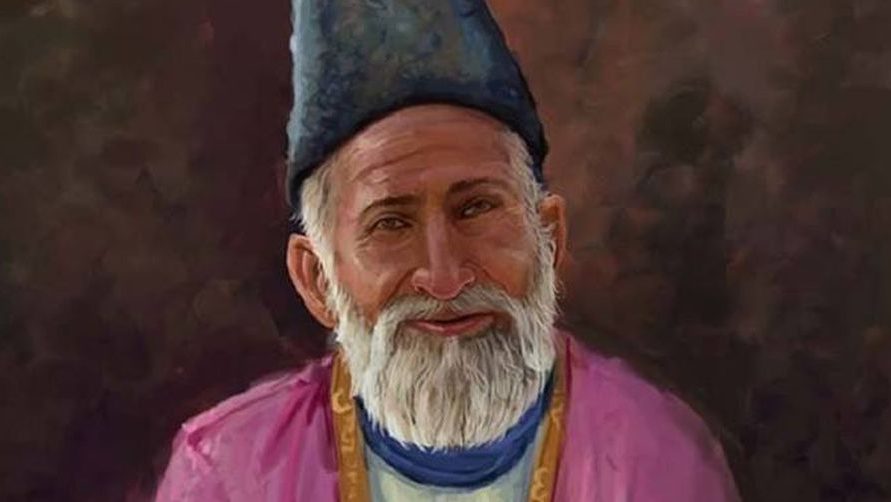
Mirza Ghalib is widely regarded as one of the greatest poets of the Indian subcontinent. Born in 1797 in Agra, Ghalib’s poetry has left an indelible mark on Urdu literature and continues to be celebrated and admired by readers around the world.
Early Life and Education
Mirza Ghalib was born Mirza Asadullah Baig Khan on December 27, 1797, in Agra, in present-day Uttar Pradesh, India. He was the youngest son of Mirza Abdullah Baig Khan, who was a nobleman and high-ranking official in the court of the Mughal emperor. Ghalib’s mother died when he was only five years old, and his father died when he was eleven, leaving him and his siblings in the care of their uncle.
Despite his privileged background, Ghalib faced financial difficulties throughout his life, as his family’s fortunes declined after the British East India Company took control of India. He was educated in Persian and Arabic, the languages of the court, and received a traditional Islamic education, studying the Quran and other religious texts. Ghalib was also well-versed in Urdu, which was emerging as a language of literature and culture in northern India.
Literary Contributions
Ghalib began writing poetry at a young age and became one of the leading voices of the Urdu ghazal, a poetic form that had its roots in Persian poetry. Ghazals typically consist of rhyming couplets, with each couplet expressing a complete thought or idea. The first couplet is known as the matla, and the last couplet is known as the maqta. Ghazals often explore themes of love, longing, beauty, and the transience of life, and require a deep understanding of language and metaphor.
Ghalib’s poetry is known for its complexity, depth, and subtlety. He was a master of language and used intricate wordplay, metaphors, and allusions to convey his thoughts and feelings. His poetry often explored themes of love, loss, spirituality, and the existential dilemmas of human existence. Ghalib’s work is also marked by a sense of irony and skepticism, as he questioned religious and social conventions and the hypocrisies of the ruling classes.
Ghalib’s poetry was deeply influenced by his life experiences and the tumultuous times in which he lived. He lived through a period of great political and social upheaval in India, as the Mughal Empire declined and the British East India Company took control of the country. Ghalib also faced personal tragedies, including the death of his wife and children, which he often expressed in his poetry.
Legacy and Impact
Ghalib’s poetry has had a profound impact on Urdu literature and culture, and his influence can be seen in the works of later poets, writers, and artists. His poetry has been translated into many languages and is widely read and admired around the world. Ghalib is also known for his contributions to Urdu prose, including his letters, which are considered masterpieces of Urdu literature.
Ghalib’s influence extends beyond Urdu literature to other areas of Indian culture. He is often cited as an important figure in the development of the Urdu language and is credited with helping to establish it as a language of literature and culture. Ghalib’s poetry has also been set to music and sung by many leading ghazal singers, including Jagjit Singh, Nusrat Fateh Ali Khan, Ghulam Ali, and Mehdi Hassan.
 Shayari Classics